
A U in Partnership to Host 2025 International Day for Disaster Risk Reduction
Collaboratively, Alupe University will host this year’s International Day for Disaster Risk Reduction (IDDRR), under the global theme “Fund Resilience, Not Disasters.” The event will bring together national and international delegates, policymakers, researchers, and community leaders to advance the conversation on proactive disaster risk reduction (DRR).
In the wake of sustained call to finance the sector, partnering entities are calling for togetherness in funding resilience – because resilience pays. The event will see Alupe University’s key partners including the County Government of Busia, the Kenya Red Cross Society, and Dhamira Moja CBO (that operates in Busia).
Kenya is joining the global community in calling for increased financing to fund resilience, not disasters. Hosting IDDRR 2025 in Busia County provides a powerful reminder that investing in resilience today saves lives and livelihoods tomorrow. Investing in resilient infrastructure, early warning systems, anticipatory action, social protection, and climate-smart development will save lives, reduce losses, and secure sustainable development gains for generations to come.

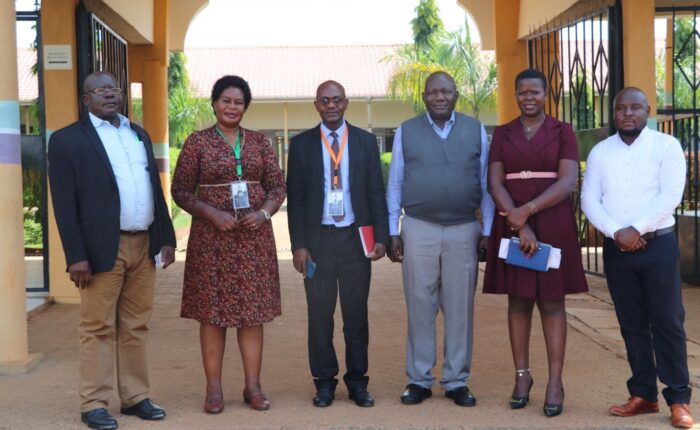
Photo 1: L-R: Mr James Akello (County Coordinator_ KRCS), Prof Orina (DVC_ARSA), Prof Toboso (DVC_AFD), Mr Solomon Abwaku (Chief Officer Governorship _Busia County), Ms Sara Martha (CEO Dhamira Moja CBO), Mr Joel Osinya (Director Risk Management)
Busia’s track record in disaster management and resilience-building provides powerful lessons, not just for Kenya but also for the wider East African region. As the host institution, Alupe University is proud to provide a platform for dialogue, knowledge-sharing, and innovation in disaster risk reduction. This aligns with the university’s vision of fostering research and community engagement that directly addresses regional and national challenges.
Kenya remains highly vulnerable to a wide range of hazards, including floods, droughts, landslides, wildfires, disease outbreaks, terrorism, and road traffic accidents. Among these, floods and droughts are the most frequent and devastating, often resulting in displacement, loss of lives, destruction of infrastructure, and major economic setbacks.

Photo Credit: Meta AI, depicting floods in Busia County
Globally, disasters now cost an estimated USD 202 billion annually in direct losses, with total impacts reaching USD 2.3 trillion when factoring in cascading social and economic effects. In Kenya, disasters erode 2–2.4% of GDP annually, undermining development gains and trapping vulnerable households deeper into poverty.
Despite this, less than 1% of most public budgets in Kenya are allocated to DRR, with international financing also stagnating. This underinvestment leaves governments and communities trapped in a cycle of expensive response and recovery instead of proactive resilience building.
Hosting the 2025 IDDRR observance in Busia County is both strategic and symbolic. Located along the Kenya–Uganda border, Busia is prone to cross-border flooding and other hazards, making it a critical site for resilience discourse. Delegates will have an opportunity to witness both the challenges faced by vulnerable communities and the innovative interventions already underway—such as dredged canals, protective dykes, and lightning arrestors.

Photo: Flooded section of Munana village in Samia Sub County, Busia County
Credit: Ok’ongo Oduya. Available at: https://www.talkafrica.co.ke/
The 2025 IDDRR observance will serve as an opportunity for Alupe University to showcase its commitment to partnerships that advance resilience and sustainable development in Kenya and beyond. To coordinate DRM, Kenya has established several national institutions, including the National Disaster Operations Centre (NDOC), National Disaster Management Unit (NDMU), NDMA, Climate Change Secretariat, Kenya Space Agency, NEMA, and the Kenya Meteorological Department (KMD).
County-level DRM structures and units have also been operationalized. At the multi-stakeholder level, the National Platform for Disaster Risk Reduction (DRR), established in 2004, plays a pivotal role in policy development, strategy formulation, training, and coordination of DRM actors. It has influenced key policy milestones, including the National DRM Policy and the draft DRM Bill. The Platform, supported by Sendai Focal Points, ensures Kenya adopts an all-of-government and all-of-society approach to resilience building.
By Victoria Magar & Savai Sabwa,
Alupe University Media